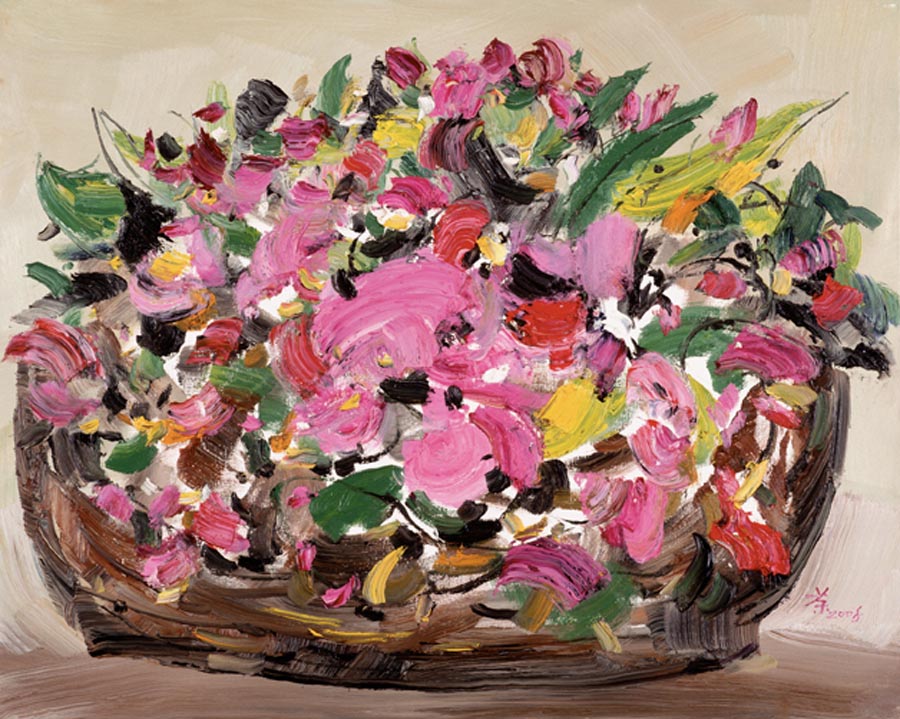
Wu Guanzhong
Introduction
Wu Guanzhong (1919-2010) is celebrated as one of the most significant figures in modern Chinese art. Possessing a unique ability to blend Western painting techniques with Chinese aesthetics, Wu pioneered a style that garnered international acclaim and brought widespread recognition to Chinese art on the global stage. His works, which include both traditional Chinese ink and oil paintings, are characterized by a dynamic and poetic style that reflects his deep understanding of both traditions. Throughout his career, Wu devoted himself to art education and made substantial contributions to the cultural exchange between East and West. His legacy is cemented by his numerous donations to public museums, ensuring that his art remains accessible to the public and continues to inspire future generations.
Early Life
Wu Guanzhong was born in 1919 in Yixing, Jiangsu province, in East China. His early life in this culturally rich region influenced his artistic outlook, instilling in him a profound appreciation for the natural beauty and traditional culture of his homeland. Although little is documented about his childhood, it is evident that the landscapes and cultural heritage of Jiangsu province left an indelible mark on his artistic sensibilities. This early exposure to the natural and cultural scenery of his surroundings would later manifest in his works, where he often depicted the beauty of Chinese landscapes with a unique integration of Western and Chinese artistic elements.
Education
Wu's formal education in art began at the Hangzhou Fine Art School, now known as the China Academy of Art. Here, he honed his skills in traditional Chinese painting while also being exposed to Western artistic techniques. The pivotal moment in Wu's educational journey came in 1947 when he traveled to France to study at the prestigious École nationale supérieure des Beaux-Arts in Paris. This experience was transformative, allowing him to immerse himself in various European art movements and study the works of great Western masters. The blend of Eastern and Western art education would define Wu's artistic style, as he sought to bridge the two traditions through his innovative works.
Artistic Career
Exploration of Chinese and Western Techniques
Wu Guanzhong's artistic career was marked by his relentless pursuit to merge Chinese traditional art with Western techniques. His education in France introduced him to new perspectives and methodologies, which he adeptly combined with his deep-rooted understanding of Chinese art. Wu's exploration led to a distinctive style that resonated with both Eastern and Western audiences. He utilized the vibrant color schemes and composition techniques of Western oil painting while maintaining the philosophical depth and fluidity characteristic of Chinese ink painting. This harmonious fusion is evident in his landscapes, where the interplay of colors and lines creates a poetic and evocative visual narrative.
Major Works and Style
Wu's major works reflect his innovative approach and mastery of technique. Among his renowned pieces is Along the Fuchun River, an oil painting that captures the poetic essence of the Fuchun landscape with a symphony of colors and forms. Another significant work, Awakening, showcases Wu's experimentation with abstract expressionism in Chinese ink painting, highlighting his focus on the dynamics of lines and dots. Throughout his career, Wu's style evolved, yet consistently exhibited a balance between realism and abstraction, traditional and modern, capturing the essence of both the natural world and the human experience with an elegant simplicity.
Teaching and Influence
Wu Guanzhong's influence extends beyond his artistic creations to his role as an educator. He taught at several prestigious institutions, including Tsinghua University. His teaching philosophy emphasized the importance of understanding Chinese art traditions while also embracing new ideas and techniques. Wu inspired countless students, encouraging them to explore and innovate, just as he did throughout his career. His commitment to art education and public accessibility is further exemplified by his generous donations to museums, ensuring that his works would continue to educate and inspire future generations of artists and art lovers.








